It came naturally to me. I was libertarian and later found out there was a Party by that name. I believe in the ideals of individual liberty, individual responsibility, private property, and free markets.
Why run for office?
I’m seeking office because my heart is invested in my community.
BZ: My book is novel about a guy who questions the shape of the earth, and in particular whether it is flat and stationary or spinning as the heliocentric model suggests.
JE: Interesting…
BZ: He thinks there is hidden land on earth that is being hidden from society so he plans a modern-day mission to find out one way or another.
JE: I have seen the flat map… and wanted to talk to sailors about following the ice around.
BZ: It is fascinating especially that I was never shown that map as a child at school, nor had I even considered that the earth could be anything other than a spinning ball.
JE: When did you first consider that the earth was flat?
BZ: I have debated flat earth and globe earth for about 6-years now, and moderate some very large groups that discuss the topic; one of them has over 130,000 members.
JE: Sounds like you have an opinion.
BZ: So, first tried to prove that the earth is a spinning ball and combed through everything available to us.
JE: Everything available to us?
BZ: Sorry, I should have said through all the modern research that is available to us, including real photos of earth from space. The moon missions, and attempting to measure the curvature of the earth as per the current earth curvature math.
JE: Just how much is available to us, and how long did it take you to “go through” it? This is all above my understanding.
BZ: Six years of vigorous research.
JE: How can I help you?
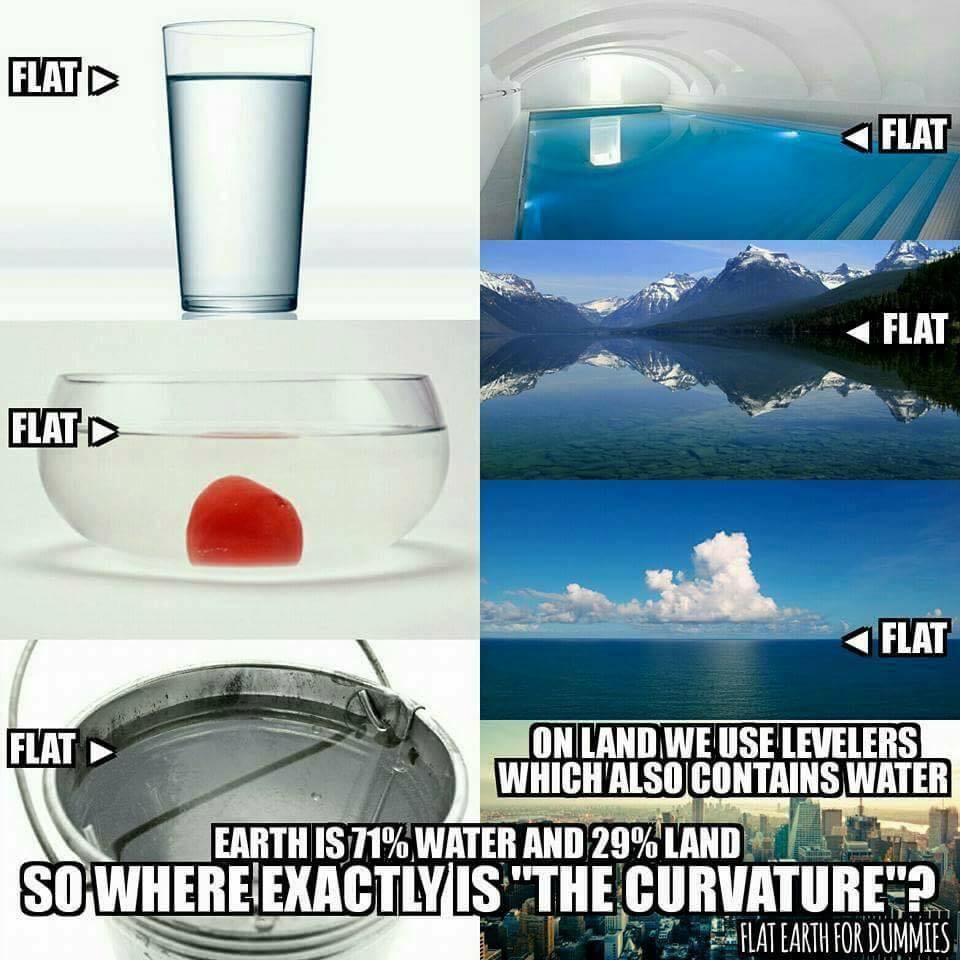
BZ: Would you agree that water is level in a glass?
JE: Not any glass I know of…
BZ: Do you know how a water level works?
JE: I have used a water level.
BZ: Awesome.
JE: So, why did you write this book? I was a big fan of Bill Kaysing…
BZ: Fluid statics or hydrostatics states that water is level at rest in stable equilibrium. We have conducted laser tests over 40 miles that proves that water is at level.
JE: Then why is it a bubble in a water level?
BZ: These experiments have been conducted across lakes and oceans and debunk the earth curvature math, which states that the earth curves at 8 inches per mile squared.
JE: I can put pennies in a glass until the water is above the edge of the glass.
BZ: That’s called meniscus as it due to surface tension; you can also create the same effect on a coin.
JE: The curved upper surface of a liquid in a tube. A lens that is convex on one side and concave on the other. “a meniscus lens.” You are right. What can I do to help you market your book? Why did you write it? What is the end game? Is there some conspiracy?
BZ: The end game is to awaken people about the true nature of reality
JE: What is the “true nature of reality?”
BZ: For one, we do not live on a spinning ball that spins at 1000 miles per hour, whilst also orbiting the Sun at 66,600 miles per hour.
Anna asked me to delete her message to me. Instead she asked me to speak about the situation in Nagorno-Karabagh so international attention can be paid, so countries at the governmental level can ask Turkey to stop it’s participation in the conflict by bringing terrorists to the region.
Armenians in the area fear a second Armenian genocide. The first was in 1915 when 1.5 million Armenians were killed and their ancient lands were taken.
I’m a stay at home parent running for Congress as a Libertarian.
Studied at Purdue University
Lives in Westfield, Indiana
I became a Libertarian after realizing that we need a third political party. Last weekend I took the world’s smallest political quiz while campaigning and I scored an 80 on the personal side and a 70 on the economic side.
I’m a new L for sure. I decided to run for office because I want to be the change I want to see in government. Less Government. Less Spending. More Freedom.
Outside of protecting our freedoms, I’m running on equality, education, and the environment. I hope to legalize marijuana. Use that taxable money to help fund education and transportation.
I want to preserve, protect, and restore our environment. I will fight for equality for all of thee regardless of gender, race, religion, sexual orientation, and any other way we categorize ourselves.
I hope to open up new agricultural, industrial, distribution, and commerce markets to increase our self-sustainability and the future for our shared pursuit of life, liberty, and happiness.
The only thing I have asked anyone is to share my story if you like it or think the voters of Indiana’s 5th District deserve to know about me.
In many ways, this is the most topical of all the independence movements as it’s in fact held a referendum on independence October 4th, 2020. First conquered by France in 1853, in 1945 New Caledonia was placed by the UN on the list of non-self-governing territories; the UN’s list of colonies.
Following the growth of European settlement in the 1960s and 70s, the Melanesian Kanak community, which currently represents about 40 percent of the population, established a pro-independence movement.
This led to violent clashes, including a serious incident in 1988. In 1998, an agreement was reached between the various parties. New Caledonia gained greater autonomy.
At the same time, it was also agreed that the territory would be permitted to hold up to three referendums on independence before 2022. The first of these took place in November 2018.
However, voters rejected statehood by 56.4% to 43.6%, on an 81% turnout. Following on from this, the second of these votes took place on 4 October 2020.
The archipelago voted to remain French with 53.26% of votes, according to final results reported by AFP news agency. Turnout – at 85.6% – was high. There’s the option for a third vote on the matter, either in 2021 or 2022.
In the event that independence is rejected for a third time, under the terms of the Accord the various parties are expected to consider the situation. This is definitely a case of ‘watch this space’.
I first heard about the Libertarian party in 2009, and have been voting for them since. I don’t belong to any political party, but I always vote for the Libertarian candidate when they are on my ballot.
I have always voted for the person running for office, not any particular party. My dad was a Democrat and my mother was a Republican. My mother was a Republican for most of her life, but she often voted for the person she liked rather than the party she belonged to.
What is your vision for this country and the world? What would you like to see happen?
I would love to see no more wars and free weed for anyone who wants it. I want the world to be a better place than it is now. I would love to be able to travel anywhere without having to have a passport.
How do you see these changes occurring?
We can start by voting for anyone but Trump and Biden, and move forward from there. I don’t agree with everything that the Libertarian party stands for, but I don’t think anyone really agrees with everything that their party stands for either.
I like the idea of free trade and no income tax.
What can Self-Determination Advocates do to help?
Get the word out that people can make their own decisions and not believe everything that the tv tells them.
As a young person growing up in Zimbabwe I was moved by the sheer growth in disrespect of property rights. This is in reference to the endless urban land disputes due to municipal official’s corruption.
The tyranny of urban land corruption in Zimbabwe has grown to the extent that families are losing lifetime savings to corrupt municipal authorities who fraudulently allocate and dispose of urban land.
Up to date urban land transactions mostly carry some shades of criminality by both the city officials and the local land Barrons. The frustrations and prejudice of home seekers motivated me to become a classic liberal.
I am a liberal who is focused on economic liberalism. The vision of the African Students for Liberty is to prepare young Africans for a freer future. As a classical liberal whose sights are set on raising awareness on the need to respect property rights, I intend to roll out an online free-market advocacy initiative that will be centered upon creating avenues to dislodge deep-seated intolerance towards property ownership.
Southern Africa still bears some remnants of the cold war communist governance structures through the revolutionary parties that draw some sentiments from the Chinese centralized system.
This is problematic in the promotion of property rights and also the need to create a transparent land market in which the government plays a minimum role.
There is a need to assist in the creation of a body of knowledge that reinforces the need to open transparent land markets and also advocacy toolkits to build community awareness.
I joined SFL when I was doing Free-market work with a local think tank, Comaliso in Zimbabwe. Urgent need that is key in my work are Advocacy tools and also assistance in crowdfunding to ensure that a lot of work is done in the ideal time frame.
We need to make payments to online platforms and promoting pages and also training in conducting online sessions and effective usage of online platforms that are popular in Africa.
There is WhatsApp, Linked-In, Facebook (partially free in most countries), and Zoom for meetings.
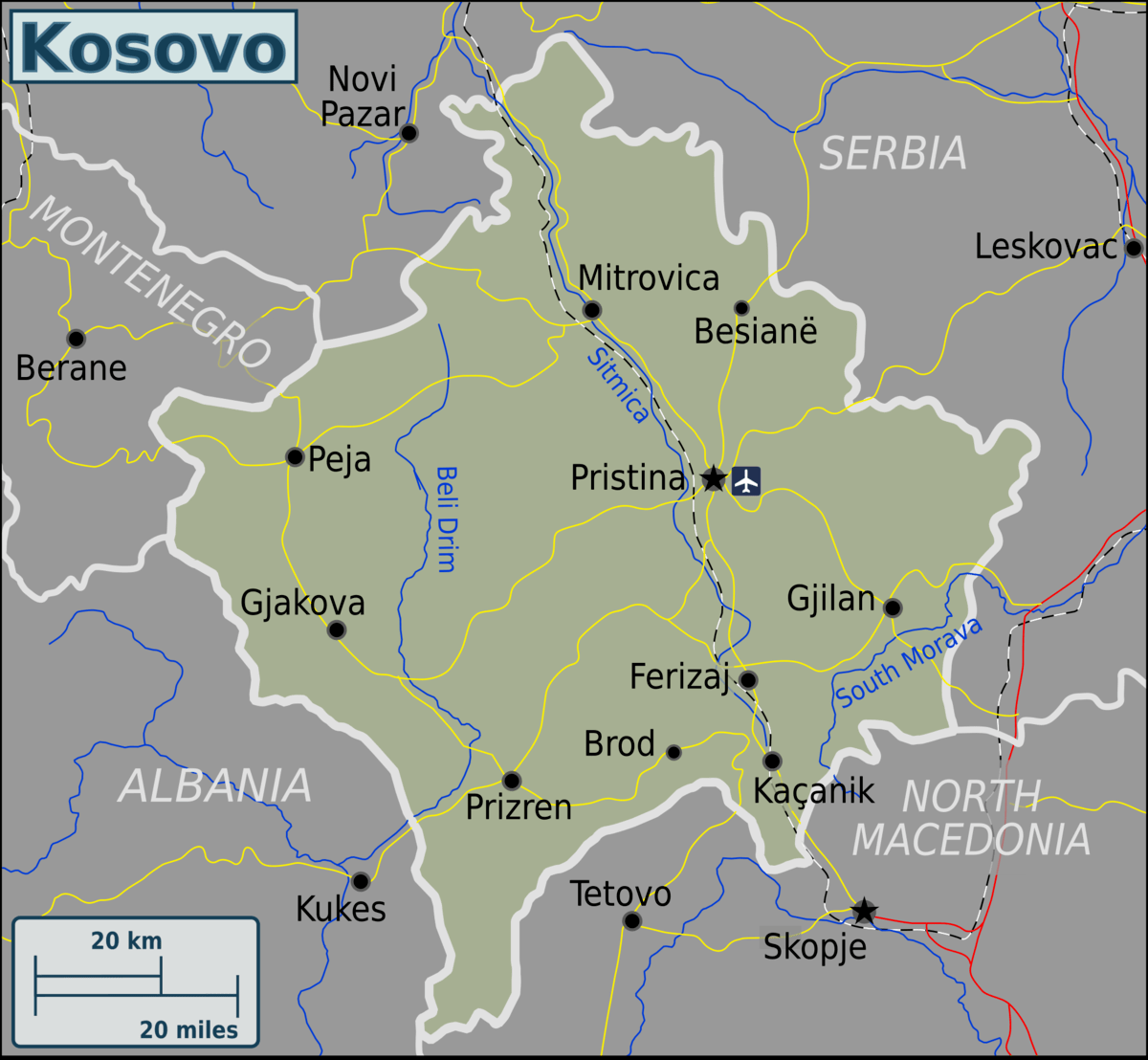
Formerly an autonomous province of Serbia within the Socialist Federal Republic of Yugoslavia, the largely Albanian-inhabited territory was stripped of its autonomy in 1989.
In 1991, an unofficial referendum was organized that showed overwhelming support for independence. However, this went all but ignored internationally.
In the mid-1990s, Kosovo Albanians launched a guerrilla campaign to press for independence. And in 1999, after a major escalation of tensions between the sides, NATO intervened.
Following a 78-day bombing campaign, Kosovo was placed under UN administration pending a decision on its final status. UN-mediated talks on the future of Kosovo began in 2006.
And while Serbia offered extensive autonomy, Kosovo demanded nothing short of independence. And on 17 February 2008, following two years of unsuccessful negotiations, Kosovo unilaterally declared independence.
Although it’s since been recognized by the United States, Britain, and almost a hundred other countries, its statehood has been rejected by Russia and China.
As a result, it is unable to join the United Nations. In the meantime, the European Union has led a dialogue process between Serbia and Kosovo with the aim of normalizing relations between them.
Ultimately, there’s no prospect that Kosovo will be reintegrated back into Serbia and it’s expected that Serbia will in fact eventually recognize Kosovo – even if only to secure membership in the European Union.
The question, therefore, is what the price of that recognition will be.
In many ways, this is a territory that under other conditions would already be an independent state and a full member of the United Nations.
Colonized by Spain in the 19th century, in the 1960s the United Nations called for it to be able to exercise its right to self-determination. However, this was strongly opposed by neighboring Morocco and Mauritania, both of which laid claim to parts of the territory.
They referred the case to the International Court of Justice, which found that neither, in fact, had a historical claim to Western Sahara. In early 1976, Spain withdrew from the territory.
And on 27 February 1976, the Sahrawi Arab Democratic Republic (SADR) was proclaimed. However, sovereign statehood was thwarted by Morocco and Mauritania, which occupied the territory.
Although Mauritania departed a few years later, to this day Morocco remains in control of two-thirds of Western Sahara; despite the fact that its claim to that territory has not been officially recognized internationally.
Meanwhile, a Western Saharan government-in-exile operates out of neighboring Algeria. According to an UN-brokered agreement, the territory is meant to hold a referendum on its future.
However, this has been continually opposed by Morocco and it’s unclear when the vote will be able to take place – if at all.
For many centuries, Scotland existed as an independent kingdom until, at the start of the 17th century, the crowns of Scotland and England were united.
Then, a little over a century later, in 1707, the two countries formed a political union, creating the Kingdom of Great Britain. Despite this, Scotland retained many distinct elements of identity, including its own legal system.
In the late 1990s, Scotland was granted a greater degree of autonomy and a Scottish Parliament was re-established. This in turn led to increasing calls for independence.
In September 2014, following an agreement with the British Government, a referendum was held. By 55.3% to 44.7% on an 84.6% turnout, voters chose to remain in the Union.
Although many thought that this would settle the matter for a generation, calls for independence have continued. This has largely been driven by the 2016 referendum on leaving the European Union.
While Scotland voted overwhelmingly to remain in the EU, the “leave” vote in the far more populous England won. Scotland also argues that its voice has been ignored in the subsequent Brexit negotiations.
As a result, the Scottish Government has announced its intention to hold another independence referendum in 2021. However, the British Government insisted it won’t permit another referendum within the lifetime of the current British Parliament, which is expected to run until 2024.
This obviously paves the way for what could be a very serious constitutional showdown.





 Self-Determination Advocates