Brett Lee

Transparent and Authentic AF!

Hardcore Libertarian!

#TaxationIsTheft

How did you become interested in Self-Determination?

You invited me to the group, then asked me to look at a website that the link given took me to some admin portal only though, and never pushed it further though.

Just been a member of this group since my time is occupied with other things, sometimes offline. 

What kind of Advocate do you identify as?

If I were to have a collective to identify with more so than others, I guess it’s the police accountability advocate followed by what I guess they are called is “truthers” as the collective of this type of activist, then thirdly libertarianism, so forth. 

I believe in individualism very greatly, the same individualist concepts applied in all 3 above.

What would you like to see happen? What is your vision for your country and the world? What would I reasonably like to see happen, what would I desire to happen without limits, and what is my goal to make happen in this world are all completely different answers. 

(Reasonably) I would like to see us as a country take control again of our government again and lead the world as an influence, not a force. The dependency mindset is from a very trained mindset with both oppression and terrorism to those that oppose within most eastern and southern cultures. 

Most Americans haven’t read their Declaration of Independence, let alone can repeat their Bill of (INALIENABLE) Rights. These are the 10 basic ideas of God-given/born-with rights to human life. 

Who is so foolish to be so WILLFULLY Ignorant of their own rights and why they have them? The oppressed within state education curriculum rather than the local demands curriculum as it once was supporting parents rights over the state’s oxymoron of rights as a corporate entity as they make the excuse to call themselves here. 

The moment we see that we need demand for independence again, we will see an uprising in limitations in demand across the spectrum. When the Government doesn’t meet this demand amongst the people, people assume they will use the powers they have against the people rather than supply limited government, including in the Declaration of Independence’s worst-case assumption giving us a right of revolution. 

Instead of letting the tree of liberty rot, we need it to ripen. We can all reasonably see this happen with plenty of civil options to force the government’s hand once we have over 3.5% of the population demanding independence and ripple effecting this message to greater united lengths again. 

Anyone that assumes government power is anything’s greater than their efficiency is oppressed. If anything, the government is infamously known to arm the enemy. Stories I hear from vets wasn’t a psyop with the enemy, it was laziness and cutting corners to save time within their spending budgets. 

Personally, I support the constitutional republic as the lesser evil of government including anarchy. Returning us to a minimal state is completely reasonable to civilly obtain in our lifetime again with the right members being elected to fill this demand. 

The worries of vote integrity have been challenged since Bush in 01 won with machines that gave out incorrect readings without accountability to my knowledge alone.

We want more accountability in these elections. We need to practice what we preach and create a third-party nonprofit that can hold integrity to the voting systems. 

If that’s getting donations to massively call centers merely to request who they are voting to hold accountability to the election results rather than being used for any person’s analytics could be a true source of evidence. 

A private business will care more about the integrity of its result than a department. Double names, dead names, etc would be more easily checked than even our cheap voting system we use. 

We have so many ways to help the integrity of our systems besides running our mouth. People act like they rather complain than hold such integrity to these systems at times sadly, it’s nothing new.  

(My Way) If I had my way, I would restore the constitutional republic and have a system of election based on who would serve rather than election via democracy.

I would offer voluntary taxation to supply and demand governments temporary programs that never seem to stay temporary. The same way you file a W-2 would be how we know to collect for let’s say Roads, USPS, SSI, Conservation Efforts, etc that people often support funding.

I would end the War on Drugs which has caused more persecution from racism via collective profile, lack of accountability, etc. than any other thing in recent history within America. 

I would keep the courts and restore peace by killing police as law enforcement off for peacekeepers. We need more towns like Andy Griffith, not Chicago 911.

The only thing stopping us is the government acting like slave keepers holding the fields down in enforcement. Like George Washington and MLK Jr, both have stated, “if a law is unjust, you are more than obligated to break it.”

You can’t have a fair trial when the trial is based on participating in the criminal act rather than justice in the individual’s situation again.

(My Goal) What I want to see happen in my lifetime that I can try to influence is the local area around me. Currently, I don’t know if this is my final settlement or not locally in WV as with how gov acts, but that’s everywhere. 

My goal would be to change and influence what I can locally to create a world better than what I left it. To me, that means a more small L Libertarians sense. No one knows what’s best for you than you. 

If that means I run for sheriff to run my mouth only to plant the seeds, so be it. If that means getting out there and being mocked, so be it. Not everyone has learned how to handle this message of liberty in the age of security, but the best argument is to the one that questions everything. 

He or she will have tough times for many others. The simplicity and honor of the message to me is the most important part of being undisputable. Did Jesus need to break your ears with his parables? 

Or did he shorten things into metaphors that made sense? This is why I enjoy cool trends like Behrman’s TaxationIsTheft, cause without consent it is regardless of how we joke or justify its existence.

Like the old proverb, “they can try to bury us, but they did not know we were seeds.” I personally like to work more behind the scene than run for office or anything, but when we have no one else willing to and you know about this demand, I feel we are more than obligated to do this when we can if we want to see the change in the world that we claim we want to see. 

In my eyes, it’s that any and all liberty we hand over we might as well expect to be a slave, as HL Mencken regularly used to point out back in the 1900s and as I see it no different today.

How do you see these changes occurring?

How is the easiest part once we have created the demand. The demand for individualism is the goal here; to ripen the tree of liberty again. That takes blood, sweat, and tears (many aren’t willing to break) to do. 

Those that are are creating that ripple that has finally reached youth as much as the other sides have. This hits them, as Vermin Supreme points out, where children are naturally rebellious.

This ripple effect reached these stubborn youth better than any authoritarian message ever will. Why? Cause it connects the dots their authoritarian parenting parents never did.

You can’t have blind obedience and expect loyalty from rebellion. Morals teach what we need to know. Morals in the individualist message show how to be moral rather than obedient so you are never lost for loyalty in the same light. 

Most worry about the infighting of self-proclaimed Individuals, but they haven’t seen the NewGen Consoles on an FPS lobby like COD or Destiny, etc. Some of the freest talking and malicious speech you could ever hear will be spoken there on all sides. 

The true free world will sound scary, but really it’d just be everyone expressing themselves freely again. The NPC professionalism lifestyle has gone too far into private people’s lives.

All of this is reachable by influences like such above and a proper message being the downfall of government by creating a ruthless demand for minimal Government like no other. 

The true gamble will be, would they use the powers they have to keep the powers they have from preventing the people from demanding liberty again.

If so, what then and why is that talk so censored within the 2A mainstream culture when preventing foreign and domestic terrorism by definition is the 2A’s purpose. 

Terrorism is intimidating people and seek of a political aim. If terrorism by definition doesn’t define our modern idea for our justice system from the police to how the feds treat Snowden, I don’t know what does. 

We need to expel these ideas in my honest opinion. When we do we succeed.

What can Self-Determination Advocates do to help?

Not sure what this group could do to help with this activism style advocacy besides take awareness of these ideas of demands in indivisible natures. I don’t follow the group like I do some I source often for my activism but figured I’d take the time to answer these questions.

James Toller

What is your vision of a perfect society?

A society that works only for the people.

For the people?

The society that we are living in today only works in favor of the government. The people must control the government as should society.

How can we change that? What would a society where the people control the government look like to you?

The government putting a “people first” initiative in place would be a good start.

So you advocate a “people first” initiative?

I advocate working only for the people and not the government.

And your vision of the world… where that can happen?

This is my vision for the state. If we want to fix the problems of the country we must work on fixing the states first. I will solely vote with what the constitution states. If it has nothing to do with the constitutional right then the people will tell me how to vote.

So, you follow the constitution, then the people?

Yes. And if there was an amendment to the constitution to come up then I would refer to my constituents. I am going to be transparent about everything that goes through the house. I already have a website put together on my first day so that all Kentuckians can and will know what is going on.

Have you heard about representative bots? you are asked like a hundred questions… then the bot votes for you… so you don’t have to read everything?

I have but I want to be the voice of the people, not a bot.

I understand… so how do you see us getting to where the government puts people first?

By putting in representatives that don’t care to fight against the government. I have fought and protested against the government. I have with the coal miners in eastern Kentucky also with the truck drivers in Washington DC.

So, you think if we get enough anti-government representatives… it could happen?

I do believe that. And I am not completely anti-government. We just need a government that is a lot smaller.

Yes, I agree… let’s work toward less government… and see how far we get

I’m game for that.

New Zealand, Liechtenstein, and Switzerland seem to be about the best we have now…

Yes, Switzerland armed and neutral.

In Liechtenstein, any group can secede, they don’t have a currency or an army…

Freedom/Cost of living

Where can you go and get the biggest bang for your buck in terms of human freedom? It’s weird; I would think that the freest places in the world would also have the cheapest cost of living, but that is not the case. 

It seems that the cost of living goes up with personal freedom. I am using Numbeo’s Cost of Living Plus Rent Index.

It uses New York City as 100. A single person’s estimated monthly costs are $1,316.50 without rent in NYC. Add a 1 bedroom apartment outside of city center at $2,006.66 and it will cost you $3,323.16 to live in NYC.

The freest country according to Cato’s Human Freedom Index is New Zealand with a cost of living of 52.31. In Christchurch, New Zealand (COL+R 57.43) a single person’s estimated monthly costs are $942.67 (1,328.81NZ$) without rent. Add an apartment (1 bedroom) outside of city center for $811.38 and it come’s out to $1,754.05.

If we go down the Human Freedom ranking 5 places to Canada. It has a COL+R of 48.21. In Quebec City (COL+R 44.51) a single person’s estimated monthly costs are $816.55 (1,047.56C$) without rent. Add a 1 bedroom apartment (506.66) and it comes to $1,323.21.

Down 2 more places, we come to Estonia at #8, with a COL+R of 34.26. In Tartu, Estonia (COL+R 36.83) a single person’s estimated monthly costs are $754.65 (616.72€) without rent. Add an apartment (1 bedroom) for $368.54 and you get $1,123.19.

The US is tied with the UK on the Human Freedom Index at 17th place, with a cost of living of 56.69 (US).  El Paso has a COL+R of 39.77, A single person’s estimated monthly costs there are $730.52 without rent. An apartment costs $612.14 for total expenses of $1342.66.

Down 3 more places we come to number 21, Lithuania, (COL 29.56). In Kaunas, Lithuania (31.81) a single person’s estimated monthly costs are $638.14 (521.50€) without rent. An apartment outside of city center costs $331.86 for a tidy sum of $970.

Next #37, down 16 places is Bulgaria. (COL+R of 24.32). In Burgas, Bulgaria (COL+R 25.01) a single person’s estimated monthly costs are $534.02 (855.44лв) without rent. An apartment costs $218.49 for a total of $752.51.

Down 3 more #40, Georgia. (COL+R 20.28) In Batumi, Ajara, Georgia (18.15) a single person’s estimated monthly costs are $375.83 (1,232.73GEL) without rent. An apartment (1 bedroom) outside of city center costs $186.74 for a total of $562.57.

To get cheaper than that we have to go down 15 places to #55, North Macedonia. (COL 19.98) In Skopje where a single person estimated monthly costs are $503.51 without rent, an apartment (1 bedroom) costs $216.38= $719.89.

Next, down 15 places we have Argentina, COL 19.55, and Kyrgystan, COL 16.46. They are tied for #70 in the HFI. 

Buenos Aires, Argentina (22.38) is where a single person’s estimated monthly costs are $426.84 (35,489.57ARS) without rent. Plus an apartment (1 bedroom) Outside of Centre $199.41= $626.25.

Bishkek, Kyrgyzstan (16.07) single person estimated monthly costs are $345.81 (27,905.51лв) without rent. Apartment (1 bedroom) Outside of Centre $160.63= $506.44.

If you can’t afford Kyrgyzstan you would have to try #111, India at COL 15.05. Thiruvananthapuram, India (12.38) single person estimated monthly costs are $267.59 (19,824.30₹) without rent. Apartment (1 bedroom) Outside of Centre $77.65 = $345.24.

There are countries cheaper than India, like Pakistan….. But at a COL+R of 12.38 Thiruvananthapuram, India is the cheapest city to live in, in the world according to Numbeo.

Why does the FBI arrest people in the early morning?

During early morning hours, most people are in bed, and not anticipating a visit from the police. To oppose the officers or agents sent to arrest them, they have to overcome the cobwebs that sleep brings, and that gives the cops a reaction time advantage.

The objective in serving an arrest warrant is to get the named person in custody with as little fuss as possible. If the person is someone who might try to resist arrest, flee the scene, or oppose the cops with force, it’s best for everyone that the cops come when their guard is down.

They’re going to be arrested eventually, and it’s better to do it without anyone being hurt. Unless the person to be arrested is a fugitive, actively hiding or running from the cops, service of an arrest warrant can be done in a much more civilized manner.

The investigator holding the warrant calls the person to be arrested, or, preferably, their attorney. They arrange a time and place for the person to surrender themselves to the police.

The arrested person can be accompanied by their attorney to ensure their rights are not violated, and bail (if permitted) can be arranged in advance. The arrested person can surrender, get booked, and be out the door in an hour or two with a court date to appear later.

Charter Cities and Rule of Law

Charter cities are a tool that can help countries improve governance, the key determinant of long-run economic outcomes. A charter city is a new city development granted special jurisdiction with the freedom to make deep reforms aimed at improving economic competitiveness in a country. 

Charter cities are built and largely financed by an in-country city developer on greenfield land and are administered through a public-private partnership between the developer and the government. 

Developers recoup their billions invested through rising land values as the city’s economy grows, so their incentives are aligned with the long-term success of the city.

Implementing innovative policies on previously unoccupied land frees city leaders from the difficulty of introducing substantive reforms in existing cities, where special interests and bureaucracies generally stifle reforms that can deliver broad-based growth. 

Take business regulation, for starters. Compared to high-income countries, developing countries tend to rank poorly on indices, like the World Bank’s Doing Business Report, that measure the ease of doing business. 

When it takes several months and a large share of an individual’s income just to register a business, only those already well-off can easily thrive. Starting from a blank slate, a charter city can develop a new regulatory framework, which is attractive to both local entrepreneurs and major investors.

Limiting the cost and time required to register a business and simplifying the tax system, which charter cities have the freedom to do, can make the formal economy accessible to ordinary people. 

Charter cities also establish independent arbitration and dedicated commercial courts, which can bolster investor confidence in developing markets by easing fears about arbitrary expropriation of their investments, leading to more growth-creating ventures in areas like manufacturing. 

And depending on the terms of the public-private partnership, charter cities would also possess the authority over areas like energy, health, education, and others. Reforms of this scale reach far beyond typical special economic zone reforms or what is possible in existing cities.

Rush Limbaugh: ‘We may be ‘trending toward secession’

Rush Limbaugh: ‘We may be ‘trending toward secession’ “There cannot be a peaceful coexistence of two completely different theories of life” Do you agree with him?

April Reigne We’re way ahead of Rush when it comes to secession ….https://badnarik.org/…/Making_the_case_for_Texas…

Jeff Williamson I think it’s possible. And I don’t listen to Rush for the record.

Gloria B. Jenkins I do agree with him. But I have doubts as to how actually different Democrats and Republicans are from each other. As Lincoln so eloquently said, “A house divided itself cannot stand. I believe this government cannot endure permanently half slave and half free.”

And that is true today, as well. We cannot live together when half of the country wants to be wards of the state and half want to be free.

April Reigne Gloria B. Jenkins Lincolns goal wasn’t to free slaves, it was to “keep the union together” by violently forcing States to stay. The States weren’t seceding to keep slaves but to keep from being overtaxed, usurpation of local/state govt, non-equal protection of the law, etc etc etchttps://www.battlefields.org/…/declaration-causes…

Gloria B. Jenkins April Reigne I know that Lincoln’s goal was to save the union. Nevertheless, that is what he said and he was right. South Carolina seceded because of the presumed hostility toward slavery of the elected President and they could see the mood of the nation turning against slavery.

They didn’t want to be in the minority, barred from moving around the country with their property, which they would have been.

Elisabeth Larsen He finally admitted it; I’m shocked!

Kevin Heldermon The only thing that makes the two theories different is who they “claim” to serve.

David Reeves Dibs on New Hampshire to Florida being Ancapistan.

John Elkins Florida in the Winter, New Hampshire in the summer?

David Reeves John Elkins and we got all the ports and beaches.

John Elkins Florida?

David Reeves John Elkins The entire coast… from Georgia to Virginia. lol I know greedy right.

John Elkins How is greedy, doin?

David Reeves John Elkins Or just Virginia to Florida. They can have new England.

John Elkins Who is this, “They”? you use a lot of “We’s” and “They’s.”

David Reeves John Elkins we are voluntaryist. They are statists.

John Elkins Oh, you are voluntaryist?

David Reeves John Elkins anarchist. . however you want to say it. Peaceful liberty lover.

John Elkins me too.

Greg Cantin Me too

Matthew Ryan Butts

Andy Evans Those of you in the northern reaches in Michigan – we need to talk. It’s time to finalize the divorce !! Tired of the southern counties ****ing around on us. 🙂https://www.facebook.com/freestatesuperior

Andy Evans Cascadia on the Pacific Coast, New England, and the Upper Midwest… those should all be encouraged to form their own nations. The remainder of the West, Midwest, and South could likely still co-exist for now.

John Elkins At one time there were secession movements in all 50 states and parts of Canada.

April Reigne Canada never seceded from being under the rule of royalty… At least the 13 states tried.

John Elkins April Reigne According to Human Freedom Index… Canada is Freer than the USA… and they are more open to secession…

April Reigne John Elkins they’ve yet to secede from the royal family.

John Elkins Yes, like the Channel Islands, BVI, and the Cayman Islands… some of the freest places on the planet. imho

April Reigne John Elkins I’d like to see those numbers after the global lockdowns…

John Elkins I am sorry, I don’t have the numbers… just my opinion.

Sean Leal I disagree completely. All one has to do is look at the vast and varied religious differences in this country to understand we can coexist with diametrically opposed ideas so long as they ARE NOT FORCED upon one another.

The reason people get angry at each other is because either they will be forced to accept being ruled by someone they hate, or will impose a ruler onto others who *they* hate.

A same-sex couple could be guarding their pot farm with their AR15s next door to a Catholic school with no problems until one of them forces the other how to live.

Politics injects anger and fighting into ordinarily peaceful situations.

Andy Evans Sean Leal – but force and aggression are the very definition of our current Federal Government. Every new law passed only serves to siphon more power from the States and the People.

The 10th Amendment was written for good reason, and Thomas Jefferson is surely spinning in his grave.

Andy Evans In 1900, federal spending was only about 3% of our GDP – now it can be 20% or more.

Sean Leal Andy Evans you are correct. Force and aggression ARE the very definition of the federal government. And the state governments. And the county and city governments.

The 10th Amendment is worthless. The Constitution “authorizes” the use of force. The Constitution is a document of violence.

John Elkins Yes, Sean Leal I agree, If we get a government that just protects life, liberty, and property… we will have so much less to argue and vote about.

John Elkins Andy Evans I wonder… In one of Heinlein’s novels… maybe “The Moon is a Harsh Mistress.” They had a section of the legislature whose only job is to repeal laws that weren’t doing the job.

I don’t like adding another arm of government. So, Congress’s only job is to pass laws… but we need fewer… not more.

Andy Evans John Elkins – I think the first way to stop the tide of liberty killing legislation is to starve the beast. We need constraints on both taxation and spending.

If you just limit taxation then the borrowing and money printing still continue. Every dollar that flows to the Federal treasury is another dollar seized from the free market, and much of that dollar goes toward funding more bureaucracy and more tyranny.

Mike McRedmond yes

Emily Brown

social market anarchist, trans, autistic, philosophizer, language-maker, nerd 我很痛苦 请帮忙我

How did you become a libertarian?

It started off gradually, then I got pushed far over the edge pretty hard by a video. I used to be a conservative long, long ago — however, I was compelled to question some of the inconsistencies I saw in conservative ideas; in rhetoric — specifically, with the idea of liberty. 

I spent a lot of time thinking on the subject, which gradually pushed me slightly more libertarian over time. Then I stumbled on a video by the YouTuber StormCloudsGathering called the “Declaration of Natural Rights,” which introduced me to the idea of the non-aggression principle and put a lot of things together for me. 

That pushed me over the edge pretty fast; deep into libertarian territory. My thinking has evolved beyond that video since then, but it was still instrumental to me getting past the hump of my own biases toward mainstream politics and introducing me to new possibilities.

What kind of libertarian are you?

Centrist libertarian and social market anarchist. I don’t really agree with any existing schools of thought, so I have put together my own — mutual autonomy.

What would you like to see happen? What is your vision for your country and the world?

Mutual respect for personal autonomy.

How do you see that occurring?

Direct action, mutual aid, counter-economics, and ultimately insurrection — or else not at all.

Andrew Jewell (The Badger)

Secretary at Libertarian Party of Dallas County

So my political involvement started with the “Tea Party” movement and a focus on 2a rights. But I gradually realized the GOP would never actually stand for individual freedom, only class preference. 

I voted Libertarian first in 2016, got involved with the Libertarian Party in 2019, ran as a Libertarian for Dallas County Commissioner District 3 in 2020, pulling 5.47% in a three-way race.

I used to describe myself as an Anarchocapitalist. But so many people have used that term to hide hateful and even bigoted behavior. I now use the term Free Market Anarchist.

I believe that unfettered by any governmental favoritism and restraint, people and communities will take care of their own, and the market provides for what needs arise.

What I want to see is the deregulation of anything that doesn’t harm others. The most immediate steps are; ending the War on Drugs in America, the control and attack on individual arms ownership (a free man’s last defense), and removing the system of taxation that results in over 50% of income being stolen by the government, before all is said and done.

A one-world government is the antithesis of human advancement. The greatest minority is the individual, and the right to self-determination must start there or it matters not.

Texas secession could be a great step. Catalonia’s ongoing dissatisfaction with Spanish oppression is another sign. Parts of Italy and Brazil have been seething under their voices being stolen for decades.

And that says nothing over the American and UN empires meddling in the affairs of sovereign nations the world over. We have to leave everyone else alone.

“Help” is only help, if asked. Consent matters. The only way this will come to be is via resistance. Peaceful, as much as possible. But as the American Declaration of Independence says, “But, when a long train of abuses and usurpations, pursuing invariably the same object, evinces a design to reduce them under absolute despotism, it is their right, it is their duty, to throw off such government, and to provide new guards for their future security.”

Peace is always preferred. But if oppression will not back down for reason, then free men the world over need to support each other in united voices. Educating the general public the world round on all the groups being silenced, and the peoples being oppressed, is a noble cause. 

What can Self-Determination Advocates do to help? I don’t know if it is permitted by its charter, but any support of those advocating self-determination and individual freedom is great. Getting our voices heard is the biggest struggle. 

Interviewing those fighting for freedom, for themselves or for others, and spreading their words can hopefully inspire more to speak up. Catalonia’s struggle is a large part of what inspired me to be more involved locally. 

Maybe my words could inspire others. We don’t have to accept the silence. We all deserve to speak and be heard. We all have a responsibility to humankind to unite with others and help them be heard as well.

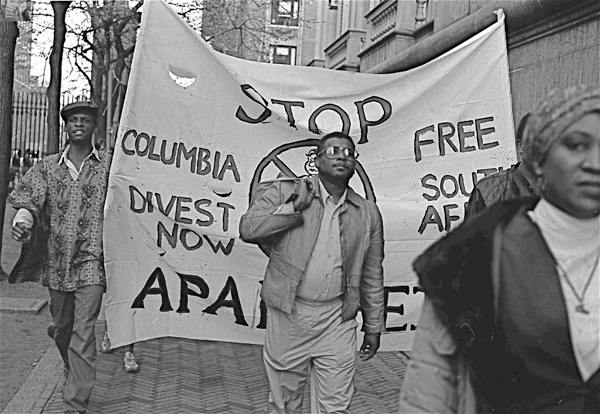
Non-Violent Method #8 Banners, posters, and displayed communications

Columbia University students win divestment from apartheid South Africa, United States, 1985

On April 4, 1985, seven students at Columbia University, members of the Coalition for a Free South Africa (CFSA), chained closed the doors to Columbia’s administrative building, Hamilton Hall, and sat on the steps, blockading the entrance.

They were there to protest the University’s investments in corporations that operated in Apartheid South Africa. Soon after, a march coordinated by other members of CFSA passed by Hamilton Hall.

When the marchers saw the small blockade on the steps, they rushed to join in. Within two hours, the seven initial protesters had seen their number grow to more than 250.

The first major successful protest in favor of College divestiture had begun. The problems in South Africa were not new when students at Columbia decided to take action.

Dating as far back as the early 19th century, black Africans in South Africa were oppressed, first by the Dutch and British colonial governments and then by the Afrikaner government that took control of the country after their independence from Britain.

Both officially and unofficially, black South Africans were radically oppressed in a grievous fashion. Though there was always some sentiment in the United States that conscientious Americans should not have been doing business with the racist Afrikaners, the protests at Columbia University were some of the first to bring the issue into the mainstream.

The blockade action was not the first action by CFSA, but rather the frustrated culmination of years of activism by student leaders at Columbia. CFSA was formed in 1982 and since their early days frequently led protests in favor of divestment.

In 1982, CFSA was able to convince the Student Senate, the most powerful student body on campus, to approve a motion to support divestiture. The next year, the more conservative University Senate, composed of students, faculty, and administration, unanimously approved a similar motion.

Unfortunately, neither Senate had any real power over the Columbia endowment. The Trustees, who did, stalled, calling the measures inappropriate.

In a concession to the Trustees, the University Senate put together a committee that would study the issue of divestment more carefully and report back to the Trustees.

The CFSA later discovered that the committee’s only real function was to give the appearance of concern for the divestment issue without ever having to actually act on it.

In the fall of 1984, the CFSA gave up on the official channels, and began to plan more visible protests around campus. They believed that escalation was the only way to win over the Trustees.

The CFSA planned the blockade for nearly two months. A week beforehand, seven leaders began a fast to demonstrate their commitment to the cause. When they met with Columbia administration a few days later to ask what they had to do to win the support of the Trustees, the administration answered “keep on fasting.”

Not only did the CFSA keep on fasting, they escalated their push. They decided to blockade on April 4 to coincide with an already-planned march for that day.

The leaders of the CFSA not only chained the doors to Hamilton Hall but were very careful to leave no opportunity for the University to claim that anyone’s safety was threatened.

There is a large network of tunnels under Hamilton Hall and the CFSA clearly marked an alternate entrance and exit. The blockade drew immediate news attention both for its visibility and the strong campus participation.

The school immediately responded by threatening to expel CFSA leaders and dozens more received disciplinary notices within the next few days. The University continued, despite a restraining order issued by a sympathetic judge preventing police action, to point out the various civil and criminal violations made by the student protesters.

The blockade, however, continued unabated. Leaders made sure that there were many blockaders there at all times so that students were able to leave and return if necessary.

The student grocery store donated food and supplies and an African-American alumni group assisted with publicity. The blockade was the predominant topic of discussion in classes, no matter the subject.

Letters of support came in from around the country and leaders like Jesse Jackson and Desmond Tutu publicly declared their solidarity with the group. Petitions were circulated among the blockaders and CFSA made frequent statements of their goal of divestment and their intention to remain in front of Hamilton Hall until they were successful.

On April 8, the fasters finally earned a meeting with Columbia University President Michael Sovern. Though they ended their fast after a somewhat productive meeting, the blockade continued.

As the legal threats mounted, more and more students were called to participate. They felt that there was no way they should miss out on being a part of such an important movement and no one wanted fellow activists to have to face the authorities alone.

When Jesse Jackson came to speak to the blockade, there were more than 5,000 students in attendance. At the height of the blockade, there were 1,000 students sitting on the steps of Hamilton Hall at all times.

Eventually, though, the crisis atmosphere began to evaporate as it became clear that there was going to be no immediate action on the part of the Trustees.

People less devoted to the movement began to lose interest and the general fatigue of CFSA leadership was beginning to take its toll. The general sense was that the blockade had been tremendously successful, but maybe it was time to try something else.

The blockade ended on April 25 with a march into Harlem to a rally. CFSA threatened continued action if the University did not take the appropriate steps to divest themselves from South Africa.

A panel composed of six Trustees was formed immediately after the end of the blockade to seriously consider divestiture. In late August, the panel returned a result that confirmed the student’s position – that divestiture was not only the moral option, but an economically viable one as well.

Because of the naturally slow work of the Trustees’ system, the recommendation was not considered until a full meeting of all 24 Trustees on October 7.

At that meeting, the Trustees adopted the panel’s recommendation and proceeded to divest the University of the remainder of their investments with South African connections.

From Global Nonviolent Action Database